Showing posts with label high school. Show all posts

Friday, March 21, 2014

Assigning Credits for Sonlight® Cores 2013 program editions and beyond

Many parents I talk to ask me how to translate the Sonlight® Core Programs into high school credits. I am not an expert on this, nor do I have any special insights or training into granting high school credits. But, I have graduated two children who used Sonlight® for high school and I can offer some idea of what is possible. My two children we accepted into state universities and a Christian college without any problems. They went on to state universities and did very well.

This is not any kind of official advice, just one mom giving you a place to start as you consider translating Sonlight cores into high school credits. You may also want to check this post on creating high school transcripts. You may also want to read this post on making a "Contract for Grade" as a way to give grades for non-test classes.

Sonlight® High School Courses changed with the 2013 editions. At this time Cores 100-400 were updated so that there is a History/Bible section and a Literature section. This actually makes it easier to assign credits.

Core F: Eastern Hemisphere and accompanying language arts. 
[I do feel this course is high school worthy. My older boys went to public high school starting in 10th grade and the Core F materials are more than they did for world history; but use your own judgment. You may want to add extra research or more in depth writing. I added further reading and more advanced writing.]

• World Cultures or Eastern Hemisphere or Eastern Hemisphere Geography: 1 credit
• English: 1 credit [If you increase the difficulty and expectations of the writing assignments and make sure they do the research in the Eastern Hemisphere Notebook]
• Geography: ½ credit if you student does all the mapping assignments and does a bit more research on the areas studied
• Bible: ½ credit

Core G or H or W LA 
[I do feel these are  high school worthy but I would only count one for high school credit. In other words, I would not use G and H for two years of study. Both are fine for a freshman course, but if you only have one year to do these and you want high school credit, then my advice would be to do Core W and possibly add in a  few books from G and/or H if you want to go more in depth. My older boys went to public high school starting in 10th grade and these studies are more in depth than they did for world history, but use your own judgment. You may want to add extra research or more in depth writing]


• Ancient World History [G] or Modern World History [Core H] or World History [W]: 1 credit
• English: 1 credit [You may want to break this down into composition and world literature, ½ credit each, but I just called it an English class]
• Bible [an elective]: ½ to 1 credit depending on time spent

Core 100-American History in Depth (2013 and beyond)

History and Bible Portion #120-MD
• American History : 1 credit
• Bible [an elective]: ½ -1 credit depending on time spent
Literature and Language Arts Portion #130-MD
• English : 1 credit [You may want to break this down into composition and literature, ½ credit each, but I just called it an English class. You could call it American Literature for 1 credit and composition for 1/2 credit. I think it would be fair to call it English (1 credit) and American Literature 1/2 credit]

Core 200- History of God’s Kingdom  (2013 and beyond)

History and Bible Portion #220-MD
• Church History or Western Civilization or World History [depending on what you child needs and what type of college, secular or Christian, they are applying to]: 1 credit
• Bible or Christian Apologetics- 1 credit
Literature and Language Arts Portion #230-MD
• English [You may want to break this down into composition and literature, ½ credit each, but I just called it an English class]
• If you child just does only literature part, you may want to call it Classic Literature and give 1 credit for it, and perhaps give ½ credit for composition.

Another mom I know counted Core 200 this way:

#220-MD
Western Civilization: 1 credit
Bible 1: Christian Apologetics: 1 credit
#230-MD
English 1: Introduction to Classic Literature and Composition: 1 credit

Core 300- 20th Century World History  ( 2013 and beyond)

History and Bible Portion #320-MD
• World History, Modern World History or World History 20th Century: 1 credit
• Bible study: 1 credit
Literature and Language Arts Portion #330-MD
• English : 1 credit
• *Modern World Literature: 1 credit

*As a note, I would give this if the student has done most of the writing assignments. If they did considerably less, I would give 1 English credit and maybe ½ credit of World Lit.

Core 400: Government/ Civics  (2013 and beyond)
[Total of 2-4 credits, using any of these combos, depending on what you covered, what writing was done, if you did the Bible, etc]
History and Bible Portion #420-MD  18 week course

  • American Government - 1/2 credit OR US History and Constitution: 1/2 credit
  • Bible: 1/2 credit 
Economics #570-00  18 week course
  • Economics 1 Credit or if you do the AP tract, 1-2 credit
Economics  Overview -- Shorter course, 1/4-1/2 credit
  • Money, Possessions and Eternity by Alcorn (#RR110)
  • The Invisible Heart: An Economic Romance by Roberts (#570-10)

Literature and Language Arts Portion #430-MD
  • American Literature: 1 credit
  • English: 1 credit
  • Or perhaps English 1 credit and 1/2 credit American Literature
Core 520: World History and Worldview Studies #520-MD
  • This could be called  World History and/or Intro to  Philosophy - I would give one credit for each. If you just want a World History course, you could use just the two "Streams of Civilization" books along with "The Universe Next Door."

Core 530: British Literature #530-MD

• British Literature: 1 credit
• English or Composition: 1-2 credits depending on the time that is spent

Psychology #590-00--10th grade and up
  • 1 credit high school Psychology, this is an advanced AP type class (could also be a Social Science Credit or used for an elective credit)

College and Career Planning 580-00
  • 1/2 credit Career Planning
What Good is Christianity? 18 week course
  • 1/2 Credit  Name it Apologetics or  Christian Influence in the Modern World
For More High School Helps

Tuesday, June 15, 2010

Transcripts, again...

Transcripts are not scary. Say it again, "Transcripts are not scary."

I have to tell you that it grieves me how much money is charged and how much scary hype there is related to creating a transcript. There are boot-camp sessions, endless numbers of books and speakers who all conspire to scare the pants off of you when it comes to transcripts.

The basic message is that your children will be jobless, friendless and homeless if you don't subscribe to their method [and it always costs money] of doing transcripts.

It isn't true.

A transcript is simply a resume of your child's high school accomplishments. It should include classes taken, grades given and some other basic information. It does not need to be in any particular format. It does not need to be done by a professional service. It does not take a genius. Simply put, it is a resume.

Now I am not saying that you don't have to keep decent records and have a high school plan so that your student has a well rounded education. What I am saying is that the transcript is just a recording of those classes your child has done. If you can keep records, you can make a wonderful transcript. Don't wait till the senior year to start trying to remember what courses your child did as a freshman--that will make you a wreck.

The secret to a good transcript, is to keep records as you go along. Assign grades as you go along and make course descriptions as you go along. It is not hard, it just takes keeping on top of writing down the records.

I once knew a lady whose son did not go to college. He went right to work and at the age of 28 decided to go into the military. They needed a high school transcript. She had never made one up, and he had graduated from their homeschool 10 years earlier. Now that is a reason to panic! She was scrambling to find records, try to remember what he had done and so forth. It was not fun! So, even if you child is not going to college or the military, please--create a transcript so that if they do need it down the road you will have an accurate resume of what they accomplished while they were in your homeschool.

Homeschoolers%27%20College%20Admissions%20Handbook
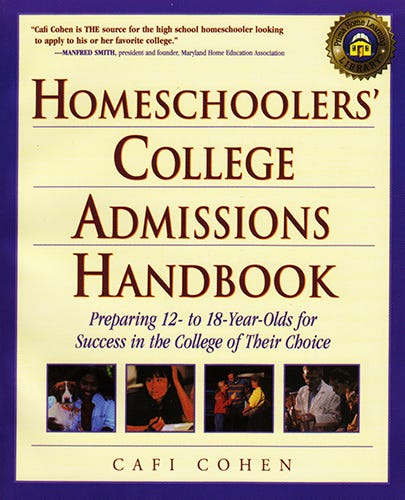
I also recommend the book, Homeschoolers' College Admissions Handbook, by Cafi Cohen. It has a lot of good information that can help with transcripts and a lot more. If you would like a sample of what I created for my children's transcripts, email me jevely@sonlight.com.

I have other high school blog posts as well and you can find them here.

Take care,
Jill

Wednesday, March 17, 2010

Transitioning to College...

Over on the Sonlighter Club Forums I see over and over again that folks want to be reassured that using a literature based curriculum will prepare their kids for college and for life.

It will.

Do you remember when you were pregnant or maybe when you first thought you might homeschool? I doubt that you checked out a text book about pregnancy or homeschooling and then answered the questions at the end of the chapter or took a final test. But, I am guessing, you learned? I am guessing, by reading real books and possibly discussing what you read and your thoughts about what you read with a friend or spouse, you learned, made decisions and had a fairly good idea of the thing you researched?

It is the same with our kids. When they use real books to learn and discuss what they have learned with you or write a response paper, they are learning--and what is more--they are learning to critically think about what they read. This is THE BEST way to learn, THE BEST way to assimilate information, THE BEST way to figure out where they stand and what they believe.

When Scotty first went to Eastern Kentucky University he was a bit hesitant. He had been homeschooled his whole life and had never taken a community college class or been in a co-op. He did have the opportunity to take a chemistry lab at our local Christian College with other high school homeschoolers, but that was the extent of his out-of-home education.

After a couple of weeks I asked him what he thought and how he was doing. He said, "Well, at first I just sat and didn't answer many questions. But, in my English class we were supposed to read some selections from Plato and discuss them the next day. When that day came, the teacher asked for us to tell what we thought and the significance of the writing. A few kids raised their hands and basically regurgitated something from the selection. But, the teacher said, 'No, what I want is what it means--what is the significance. What do you think about it?'

So, I raised my hand and told what I thought it meant, what the significance of it was."

"Kids looked at me with amazement and said, 'Did you study this last year?' and I had to answer no, that I had never seen it before. Then they said, 'How did you know that, then?' and I said, 'I just read it, thought about it and figured it out.' The teacher was pleased and I knew right then that college wasn't as scary as I thought it would be. The kids are just regular kids, the same kids who work at McDonalds. I don't know what I worried about."

And there you have it.

If you use literature to teach your children they well learn to think for themselves, learn to analyze what they read, be able to form opinions and then to communicate those opinions back orally or in writing. It will be second nature to them--they have been doing it for years. Reading textbooks and filling in blanks does not adequately prepare them for this higher level of thinking like literature based learning does.

It just doesn't.

[Note: I think textbooks can be used as a tool toward this end, if literature and discussion are used along with it. I don't think all textbooks are in and of themselves bad, but they need to be used as a tool, not to be memorized and accepted as fact.]


Take care,
Jill

[Photo: Scotty's graduation from our homeschool in 2007]

Wednesday, August 5, 2009

Narration for High School Students?


If you are homeschooling a high schooler [or two or three] this year I want to encourage you to use the time tested method that you may have used when you students were younger--narration. Many people who saw the value of this method when their kids were little forget all about it when their students are older.

Narration, as I am referring to it, is the practice of asking your child what they have read after they have read it. You can just ask for a summary of what they have read, or ask them their favorite story they read that day and why, or ask them to list the three most important points in today's reading, and so forth. I love using this with older students--and here is why...

When we did Sonlight Core 300 I had a hard time knowing what to discuss with my son. Sonlight provides tons of questions and answers, but there are so many that no one could possibly remember or understand all of them. When I asked my son the questions, many times he gave me a blank stare. [You know that deer-in-the-headlights look?]

So, I tried giving him the written questions [without the answers] and then asking him the answers later in the day. Well, being a smart student, he did what your student would probably do. He didn't read the book, just hunted for the answers-often without having much understanding of what it all meant. Not acceptable!

I tried just asking him to tell me what he had learned that day, and the blank stare again. Ugh!

Then I remembered narration. I asked him to take a highlighter and highlight the most important events/topics he read each day. He could not highlight whole paragraphs, just key words. Then, with my trusty Sonlight questions [with answer key] in my lap, I would say,

"So, what are the most important topics you read about today?"

Scotty would look at his highlighted key words [did I mention, this is a great skill to have in preparation for college] and tell me about that event. Then he would go to the next one. He would generally hit about 80% of the major topics and showed understanding of them. I would fill him in on anything he missed that was significant and tell him about topics that were in my study guide but may not have been in his book. This discussion/narration took about 15-30 minutes a day.

I think it accomplished many things:

  • It taught him to find major concepts and to weed out those that were not so important.
  • It taught him to make highlighted notes which most students don't learn to do until they are in college.
  • It gave him the opportunity to take what he had read and re-phrase it into his own words, giving his interpretation and opinion. I think this is a very important life skill.
  • It gave us a structured time to connect, review and talk about our core beliefs.
So, if you want to accomplish any of the above tasks, you may want to consider using narration with your high school student. I was amazed how much we both learned using this age-old technique.

Take care,
Jill


This worked great!

For More High School Helps

Monday, March 30, 2009

Stretching Cores--How can I do this?


Many people have asked me over the years, how to stretch a Core Curriculum out so it takes a year and a half. I have thought about this and have actually implemented the following plan and it works well. I hope it can help you too.

A school year is typically 180 days, or 36 five day weeks. However, we all know, there is no way we actually do every lesson, every day, for 180 days. I mean, no one does. That is why in my whole school career I never came close to finishing a math book. You have to figure in sick days, holiday events, field trips and so forth. So, for argument's sake, let's say we plan for 30 full weeks of school. The other weeks can be for whatever-such as I mentioned above—and/or maybe a two week Christmas school and a three week state history--something along that line. I will elaborate on these ideas at the bottom of this post. So, let's look at the 30 weeks this year and 15 weeks next year. A total of 45 weeks of school over three semesters.

Get a FIVE day core. Do FOUR days of it every week.

That's my advice.

Do days 1-4 the first week, then days 5-8 the next week, and 9-12 the next week and so on. You can either stretch out the daily work so it is an even amount each day, or do all the work in four days and use the fifth day to do science experiments, map work, time-line work and maybe give the house a nice cleaning before the weekend. Or, maybe you can have a continuing book series that isn't scheduled in Sonlight-like my personal favorite the "Little House" books-- and you read a few chapters of those on your "off" day.

Doing a core this way, gives you 45 weeks of curriculum and you haven't had to tweak or worry about pacing--just do four days every week and you will have it paced out for you.

[What this translates to, is use 12 "tabs" worth of Sonlight Curriculum every semester and you will come out just right!]

NOTES----

CHRISTMAS SCHOOL:

I started in 1990 the week after Thanksgiving! This was not a good time, but we were desperate. [To see why, go here]. At any rate Christmas and all its activities was looming.
I was so stressed out--I mean really! Ugh! School, decorating, shopping, cards, school, shipping presents--oh, my--I mean I was totally stressed out.

So, the next year I got smart. I planned for Christmas. We did no formal school for the two weeks before our Christmas break [for late middle/high school kids I did have them keep up with their math]. I had the kids help with cleaning, baking and addressing the Christmas cards. I had them help with wrapping presents, deliver goodies to neighbors and everything else there was to do. It was part of the school day.

In addition, I read great Christmas Classics--I read the Best Christmas Pageant Ever for 20 straight years. I read Dickens’s Christmas Carol and then we watched the Mickey's Christmas Carol Cartoon. Christmas was fun and not stressful. The difference--I planned for Christmas, made it part of school and included the children as much as possible. The work got done and we were not stressed out at all.

So, my advice: Plan for the times you will be stressed and incorporate your children as much as possible.

STATE HISTORY:

Most states require you to teach state history. We did it this way. We did about 2 -3 weeks or so worth of state history every year the kids were in elementary school--or at least 3-4 years.

In our case, each child got a notebook or scrapbook. They could decorate it the way they wanted. In preparation for state history studies, whenever we would go in or out of our state I would have the kids collect those shiny brochures that are in the welcome station. Also, I would have them each get a state highway map or two.

The map will have the state bird, state flower and lots of other information. Talk about this and have them cut these things out and put them in their scrapbook. Have them sort the brochures into historical things and into tourist traps. If you can, chose 1-2 historical places to visit during your state study. Take photos, talk to the interpreters or curators, learn as much as you can about these places and the people that were involved with these events and locations. Older children can do extra research and do reports, younger children can just make a scrapbook page. Keep it fun and interesting. Have your children cut up the colorful brochures and use those in their scrapbooks too.

Use the highway map to plot out how you will get to the historic site. Have your kids keep track of the miles and so forth, this will be good experience on how to read and follow a map.

Ask your librarian for good books about your state. These could be biographies or historical fiction. Do these as read-alouds during this period of study. We found some nice historical fiction about our state at the local Christian book store. Ask people in your area--perhaps the local mayor or the folks at your city hall, if they have suggestions of local historical places you can visit. My kids and I learned so much this way. It was exciting and gave us a little break from our regular routine.

Hopefully this will help you see how you can stretch your curriculum. If you have other ideas, let me know. I am always looking for ways to help and encourage homeschool parents.
[Photos of Shakertown, a historic place close to home]

Wednesday, March 18, 2009

High School Again...Contract For Grade

More high school help because I have had more than a few inquiries about this lately.

"How do I give a grade for a class that doesn't have tests?"

This could be because of many reasons. It could be a class like Co-op, or personal finance or if your student is doing literature based history, such as Sonlight. In any of these cases, your student might not have tests or daily graded work such as you would in a math or science class. How then can you give your student an objective grade?

Well, my solution is called "Contract for Grade." When my husband was in seminary he had some classes that were graded this way and I thought it was an excellent idea to use in our homeschool.

You and your spouse or you and your student sit down and hammer out a contract for each class.
It works something like this:

Personal Finance Class-1/2 credit:
In order to get an A in this class:

  • Open a checking account and balance it every month. This will entail getting an official state ID card as well, so you you can use a check at local stores.
  • Set up a spreadsheet itemizing all your monthly expenses, including a budget for things you may only need once or twice a year, such as shoes or money for Christmas gifts.
  • Help mom[or dad] pay the household bills for 3 months.
  • Pretend you are going to rent an apartment, buy a car, pay for insurance and so forth. Figure how much it will cost you to live and how much you have to make to support yourself.
  • Read Money, Possessions and Eternity and one book of your choice about personal finance [or another book you might want to specify] and outline each chapter. Discuss each chapter with a parent after you read it.
  • Do a 7-10 page research paper having to do with personal finance issues: topic to be approved by parents
In order to get a B in this class:
  • Open a checking account and balance it every month. This will entail getting an official state ID card as well, so you you can use a check at local stores.
  • Set up a spreadsheet itemizing all your monthly expenses, including a budget for things you may only need once or twice a year, such as shoes or money for Christmas gifts.
  • Help mom[or dad] pay the household bills for 3 months.
  • Pretend you are going to rent an apartment, buy a car, pay for insurance and so forth. Figure how much it will cost you to live and how much you have to make to support yourself.
  • Read Money, Possessions and Eternity [or another book you might want to specify] and outline each chapter. Discuss each chapter with a parent after you read it.
  • Do a 2-3 page min-research paper having to do with personal finance issues: topic to be approved by parents
Then you and your teen sign it. This is a contract. They know what is expected, and you know it too. You might put a completion date on it, and you might talk about penalties if it is not done on time, etc. Their written work is a paper trail and the contract is your "proof" of how you graded, in case anyone asks. You can be as general or as specific as you want to be.

I hope this gives you some idea of how you can give fair grades in non-traditional classes. This is a legitimate way to give grades, as evidenced by the fact that Bob earned some grades this way in graduate school.

Let me know if you have questions I can help you with.

Take care,
Jill

For ideas on how to give high school credits for Sonlight Cores, go here.
For ideas on how to make high school transcripts, go here.

For More High School Helps

Tuesday, March 17, 2009

High School Credits for Sonlight® Cores (Through 2012 editions)

Many parents I talk to ask me how to translate the Sonlight® Core Programs into high school credits. I am not an expert on this, nor do I have any special insights or training into granting high school credits. But, I have graduated two children who used Sonlight® for high school and I can offer some idea of what is possible. My two children we accepted into state universities and a Christian college without any problems. They went on to state universities and did very well.

This is not any kind of official advice, just one mom giving you a place to start as you consider translating Sonlight® cores into high school credits. You may also want to check this post on creating high school transcripts. You may also want to read this post on making a "Contract for Grade" as a way to give grades for non-test classes.

Core 5: Eastern Hemisphere and LA 5
[I do feel this course is high school worthy. My older boys went to public high school starting in 10th grade and these studies are way more than they did for world history, but use your own judgment. You may want to add extra research or more in depth writing]

• World Cultures or Eastern Hemisphere or Eastern Hemisphere Geography: 1 credit
• English: 1 credit [If you increase the difficulty and expectations of the writing assignments and make sure they do the research in the Eastern Hemisphere Explorer]
• Geography: ½ credit if you student does all the mapping assignments and does a bit more research on the areas studied
• Bible: ½ credit

Core Alt 7 or 7 with LA
[I do feel these are both high school worthy. My older boys went to public high school starting in 10th grade and these studies are way more than they did for world history, but use your own judgment. You may want to add extra research or more in depth writing]


• World History [Alt 7] or Modern World History [Core 7]: 1 credit
• English: 1 credit [You may want to break this down into composition and world literature, ½ credit each, but I just called it an English class]
• Bible [an elective]: ½ to 1 credit depending on time spent

Core 100-American History in Depth (up through 2012--the format was changed in 2013)

• American History : 1 credit
• English : 1 credit [You may want to break this down into composition and literature, ½ credit each, but I just called it an English class]
• Bible [an elective]: ½ -1 credit depending on time spent

Core 200- History of God’s Kingdom  (up through 2012--the format was changed in 2013)

• Church History or Western Civilization or World History [depending on what you child needs and what type of college, secular or Christian, they are applying to]: 1 credit
• English [You may want to break this down into composition and literature, ½ credit each, but I just called it an English class]
• If you child just does only literature part, you may want to call it Classic Literature and give 1 credit for it, and perhaps give ½ credit for composition.
• Bible: 1 credit
----
Another mom I know counted Core 200 this way:
Western Civilization: 1 credit
English 1: Introduction to Classic Literature and Composition: 1 credit
Bible 1: Christian Apologetics: 1 credit

Core 300- 20th Century World History  (up through 2012--the format was changed in 2013)

• World History, Modern World History or World History 20th Century: 1 credit
• Modern World Literature: 1 credit
• English : 1 credit
• Bible study: 1 credit
*As a note, I would give this if the student has done most of the writing assignments. If they did considerably less, I would give 1 English credit and maybe ½ credit of World Lit.

Core 400: Government/ Civics(up through 2012--the format was changed in 2013)Total of 2-4 credits, using any of these combos, depending on what you covered, what writing was done, if you did the Bible, etc]

  • American Government or Advanced American History: 1 credit
  • Civics or Political Science or Constitutional Law: 1 credit
  • US History and Constitution: 1 credit
  • Honors American Government and Civics: 1 Credit
  • American Literature: 1 credit
  • English: 1 credit
  • Bible: 1+ credits [Depending on time spent and depth of discussion with parent/mentor]

Core 530: British Literature

• British Literature: 1 credit
• English or Composition: 1 credit

For More High School Helps

Monday, March 16, 2009

High School Transcripts--Not as scary as you think...

I talk to lots of moms and dads every year who ask about transcripts. They are not just concerned, but many are actually very worried about this aspect of homeschooling. There are all kinds of books, classes and lectures that focus on transcripts and getting into college, and many are very good, but this post is just to give you the basics. If you want more information, I suggest you might want to get the Homeschoolers' College Admissions Handbook

In my experience, with our two homeschool graduates, it is not something to stress out over. Do not let the thought of making transcripts keep you from the joy of homeschooling your high school student. My homemade transcripts were not questioned by the state universities and Christian College my kids applied to. But, I do have some helpful hints:

  • Keep REALLY good records, starting in 9th grade, or 8th grade if you child is doing high school level courses such as Algebra, a foreign language, Biology, etc. I suggest keeping a spread sheet with the course title, the text or books used, authors and publisher, and a course description. I will put a simple course description at the end of this post.
  • If it is a course that is more hands on or does not use a traditional textbook, then you might want to keep a record of time spent on the course. For example, for a class like "Fine Arts" you might want to record events and times at the events over the course of all 4 years. You could include trips to art museums, attendance at music events and so forth. Over the course of 4 years this could be enough hours to count for 1/2 to 1 credit. A regular traditional school credit is generally equal to 140-150 hours. Most people figure since it takes less time to school using a tutorial method, it would be about 120 hours of homeschool time to count for one credit. This can vary, but this would be a fair estimate.
  • Every quarter or at least every semester, award a letter grade to the course.
  • Contact the colleges or universities you are interested, or at least go on their website to see what they want courses they want to see incoming freshmen have. I would do this when my child is in late middle school and check at least annually. Gear your 4 year high school plan so that you include what they want to see.
  • Make up a transcript-you can email [jevely@sonlight.com] me for a sample- and keep it current. If you do this at the end of 9th grade and update it annually, it will a fairly simple thing to do. If you wait till your child is applying to colleges, it can get overwhelming. I used a combination of an Excel spread sheet and a Word document. You can find samples on-line or in the Homeschoolers' College Admissions Handbook
  • Remember transcripts can look many, many different ways. Every school district does theirs different, so there is more than one right way. You can organize the credits by year or by topic--for instance putting all the English credits together. Either way is acceptable.
  • Generally, all transcripts needs a cumulative GPA, a chart for telling what point value you give to each letter grade, an official signature, the name and address of the school, name and address and birth date of child and it must be dated. Check with the colleges you are interested in to see what they require if you have any hesitation. The admission officers are looking for a reason to accept your child, so they are very helpful.
  • Remember, you child's transcript is like a resume. It should include all classes as well as a listing of extra curricular activities-these are generally included on a separate sheet, with the actual list and grades of classes all on one sheet.
  • Keep a copy of everything you send in. Also, keep a copy of your child's best written work, term papers, a sampling of math work, and other work, just in case you need to show a portfolio. We were not asked, but you would be wise to keep a sampling, just in case.
If you have further questions, please email me or ask here. bluegrassjill@gmail.com


Sample Course Descriptions:

Algebra 1
1 Credit
An interactive course emphasizing the understanding of Algebra and Algebraic terms and concepts. Topics include real number system, number theory, algebraic expressions and sentences, linear and quadratic equations, inequalities, operations with polynomials, relations and functions, graphing equalities and inequalities, radical expressions, factoring polynomials and systems of equations.

Geometry
1 Credit
This course covers the applications of geometric relationships and principles. Topics include a wide variety of constructions with compass work, inductive reasoning, points, lines, planes, angles, triangles, similarity and congruence, circles, three dimensional geometry, area, volume, trigonometry, and coordinate geometry. Understanding and real life application emphasized.

Personal Fitness/Physical Education
1 Credit
This course revolves around competitive swimming including, but not limited to: extensive practice and instruction, proper stroke formation, understanding of rules, participation in conference competitions, sportsmanship and teamwork.

Conversational Spanish
.5 credit
An interactive course emphasizing conversational Spanish with native Spanish speakers. Particular emphasis on listening and understanding basic Spanish phrases and words.

Social Studies
1 Credit
This course explores the foundations of other cultures, including their economics, geography, governments, religions and histories. This study is taught through a thorough look at Eastern Hemisphere countries. It utilizes map and encyclopedia work, as well as extensive literature, video clips, and in-depth look at how different societies and cultures have changed over time. Special emphasis on critical thinking and understanding people who are different than us. Taught in conjunction with English I.

Intro to Computers
1 Credit
Introduction to basic computer skills. This class will teach basic keyboarding, how to use the printer, digital camera, access the internet, email, on-line research and other basic applications. It will also introduce the use of Excel Spread Sheets, Word and other common software. Ethical and privacy issues will be discussed, as well as web safety.

As a note of disclaimer: I am not any sort of authority on this subject. I am just one mom telling you what has worked for us. If what I have recommended is helpful, great--but you should read some books, ask some folks and talk to admission counselors if you have any questions. Also, I have heard that there is various software available to help you with transcripts, diplomas etc. Perhaps you may want to Google "homeschool software" and see what comes up.

For ideas on how to grade non-test subjects, you may want to read this post on Contract for Grade.
And for ideas on how to give credits for Sonlight Cores, you can go here.

For helpful no-cost brochures on Record Keeping, Developing a High School Plan, Planning for College or Work, a Timeline for Keeping onTrack and You Can Homeschool Through High School; click here.

[Pictures of our two youngest children who graduated from our homeschool]


Another blog post on transcripts.